Newsletter Subscribe
Enter your email address below and subscribe to our newsletter

 ByJohn A
Industrial cooling systems can consume substantial amounts of energy, particularly when conventional electrically driven chillers are used for continuous process cooling or air conditioning. At the same time, many industrial facilities generate low-grade heat through power generation, process heating, compressors, furnaces, engines, and other operations. Much of this heat may ultimately be rejected instead of being converted into useful energy.
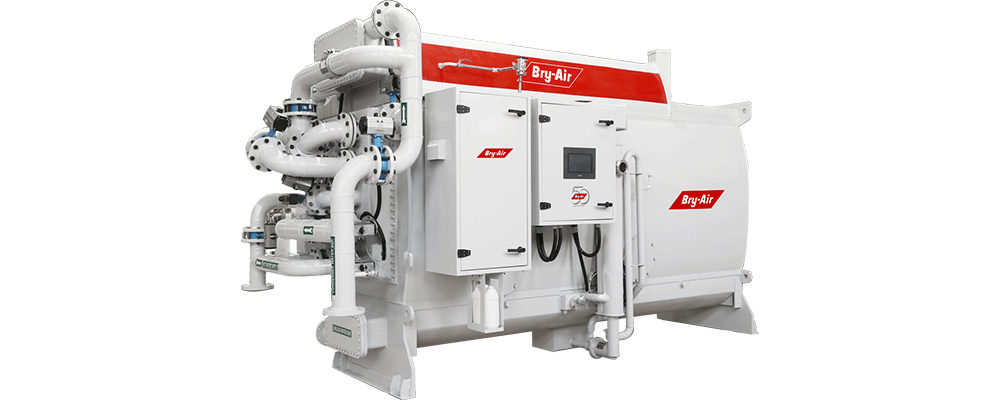
This creates an important opportunity for industries looking to improve cooling efficiency and make better use of available resources. Adsorption chillers can use waste heat or solar heat as a thermal energy source for producing chilled water, reducing dependence on electricity for the cooling cycle. Bry-Air’s product portfolio includes adsorption chillers designed around this principle, with capacities ranging from 35 kW to 1,180 kW, or approximately 10 TR to 335 TR.
An adsorption chiller is a thermal cooling system that uses an adsorbent material and a refrigerant to produce chilled water. Unlike conventional mechanical refrigeration systems that primarily depend on electrically powered compressors, adsorption cooling can use available heat as the driving energy source.
Bry-Air’s adsorption chiller technology uses silica gel as the adsorbent and water as the refrigerant. The system operates under vacuum conditions, allowing water to evaporate at a low temperature and produce the cooling effect required to chill circulating water.
For industries evaluating this technology, working with experienced adsorption chiller manufacturers can help determine whether the available heat source, cooling requirement, water temperatures, and operating conditions are suitable for an adsorption-based system.
The basic process involves adsorption and desorption occurring alternately in dedicated chambers. Water acts as the refrigerant and silica gel acts as the adsorbent. When water evaporates under low-pressure conditions, it absorbs heat from the chilled water circuit, thereby producing the required cooling effect.
At the same time, another chamber is regenerated using hot water. This drives the previously adsorbed water vapour away from the silica gel. The vapour then moves toward the condenser, where it changes back into liquid water and is returned to the cycle.
The two adsorption chambers alternate between adsorption and regeneration. This continuous cycling allows the system to maintain chilled water production while utilizing thermal energy instead of relying primarily on mechanical compression.
Waste heat is generated across many industrial processes. Power generation equipment, fuel-fired furnaces, process heating systems, compressors, engines, and other equipment can produce heat that is ultimately rejected into the environment.
Recovering this otherwise unused thermal energy can create an additional pathway for meeting cooling requirements. Instead of treating waste heat solely as an output that needs to be removed, an adsorption chiller can potentially convert suitable low-grade heat into useful cooling.
Bry-Air states that its adsorption chillers can utilize low-grade process heat in the approximate range of 50°C to 100°C. The technology can also utilize solar heat in suitable applications.
The value of an adsorption chiller depends heavily on the temperature and availability of the heat source. A facility with a consistent supply of suitable waste heat may have an opportunity to integrate cooling generation with an existing process.
This approach can support energy management objectives because the cooling system does not have to depend exclusively on electricity as its primary driving energy. The overall benefit will depend on system design, heat-source characteristics, cooling demand, operating schedule, and site conditions.
Adsorption chillers offer several characteristics that can make them suitable for industrial and commercial cooling applications. Bry-Air’s system uses water as the refrigerant and silica gel as the adsorbent, while the manufacturer highlights low electricity consumption, low noise and vibration, and low maintenance requirements.
One of the key advantages of an adsorption cooling system is its ability to use thermal energy as the primary driving source. When suitable waste heat is already available, the cooling system can make productive use of that energy rather than requiring all cooling capacity to come from electrically driven refrigeration.
This can be particularly relevant for facilities where cooling represents a significant operating requirement and a suitable heat source is available continuously or for substantial portions of the operating schedule.
The use of water as the refrigerant is another important characteristic of Bry-Air’s adsorption chiller technology. The company describes the silica gel-water pair as an advanced green technology and highlights the absence of hazardous refrigerant-related leakage concerns associated with certain conventional refrigerant systems.
Because the adsorption process does not depend on the same type of mechanically driven compressor arrangement used in conventional compression chillers, the technology can operate with low noise and vibration. Bry-Air also identifies simple continuous operation as one of the technology’s advantages.
The adsorption chiller design has relatively few moving components within the adsorption process. Bry-Air identifies negligible maintenance as one of the potential advantages and states a life expectancy of more than 25 years for its adsorption chiller technology. Actual equipment life and maintenance requirements, however, depend on installation conditions, water quality, operating practices, controls, and preventive maintenance.
Adsorption chillers can be considered for facilities where both cooling demand and a suitable thermal energy source are available. Bry-Air identifies applications across a broad range of industries, including power generation, food and beverage, chemical manufacturing, pulp and paper, sugar, aluminium, automobile manufacturing, air compressors, diesel generators, gas engines, and general industry.
Industrial processes frequently require chilled water at controlled temperatures. An adsorption chiller can provide chilled water by utilizing an available heat source rather than relying solely on electrical power.
Bry-Air’s stated chilled water output range includes approximately 5°C to 10°C, while specific operating conditions vary by model and system configuration. The manufacturer’s technical specifications also provide detailed inlet and outlet temperatures, flow rates, and pressure-drop values across its product range.
The technology is not limited to industrial process cooling. Adsorption chillers can also be considered for commercial buildings and HVAC applications where suitable waste heat or solar heat is available.
However, proper engineering assessment is important before selecting a system. Cooling demand, available heat, water temperatures, operating hours, site infrastructure, and expected load variation should all be evaluated to determine whether adsorption cooling is technically and economically appropriate.
Choosing an adsorption chiller should involve more than comparing rated cooling capacity. The relationship between the heat source and cooling requirement is central to system performance.
The first consideration is whether sufficient heat is available at an appropriate temperature. Bry-Air identifies hot water around 90°C as an optimum operating condition for its adsorption chillers, with cool water around 24°C to 35°C and output cold water around 7°C to 12°C under stated operating conditions.
The actual conditions at a facility should be measured and analyzed before equipment selection.
Bry-Air offers adsorption chiller capacities from 35 kW to 1,180 kW. This broad range allows systems to be considered for different cooling requirements, but the correct selection should be based on actual load requirements rather than simply choosing the largest available unit.
An adsorption chiller needs to be integrated with the site’s hot water, chilled water, condenser water, controls, and heat recovery infrastructure. Engineering evaluation should therefore consider hydraulic requirements, temperature profiles, flow rates, pressure drops, available space, and control strategy.
Energy efficiency is increasingly connected with industrial sustainability because reducing energy consumption can contribute to lower operating costs and reduced environmental impact. Adsorption cooling provides an approach for utilizing heat that might otherwise be rejected.
Bry-Air positions its adsorption chiller technology around waste heat recovery, energy-efficient cooling, and reduced CO2 emissions. Its website also identifies adsorption chillers as part of its broader portfolio of environmental and energy management technologies.
The sustainability value of a particular installation should still be assessed using site-specific energy balances and operating data. A system is most valuable when the available heat source can be consistently recovered and matched with a meaningful cooling requirement.
Adsorption chillers provide an alternative approach to industrial and commercial cooling by using suitable waste heat or solar heat to drive the refrigeration cycle. By combining silica gel adsorption technology with water as the refrigerant, these systems can produce chilled water while reducing dependence on conventional electrically driven cooling.
The technology can be particularly relevant for facilities that generate recoverable low-grade heat and have continuous or recurring cooling requirements. Bry-Air’s adsorption chiller range covers capacities from 35 kW to 1,180 kW and is designed for applications across industries including power, food and beverage, chemical, pulp and paper, automobile, sugar, and other process industries.
For organizations assessing whether adsorption cooling is suitable for their facility, the most important step is a technical evaluation of the available heat source, cooling load, water temperatures, operating conditions, and integration requirements. To discuss application requirements and identify a suitable cooling solution, businesses can Contact Us with their project details.