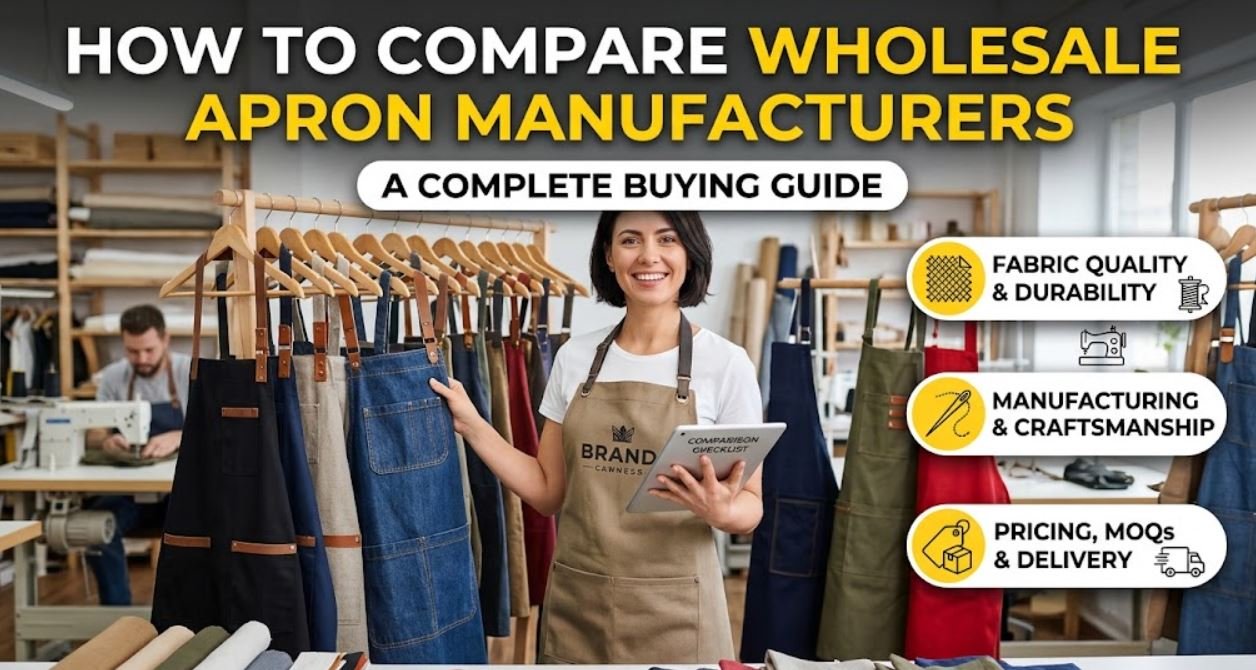

Choosing the right wholesale apron manufacturer is important for businesses that need quality products at competitive prices. Whether you own a restaurant, salon, barbershop, cafe, retail store, or clothing brand, working with a reliable supplier can help you maintain product quality and manage costs.
Wholesale apron manufacturers offer different materials, designs, customization options, and minimum order quantities. Comparing these factors before placing an order can help you find an apron supplier that meets your business requirements.
In this guide, we explain how to compare wholesale apron manufacturers and what to check before making a bulk purchase.
1. Compare Apron Quality and Materials
The first step is to check the quality of the aprons. A low price may seem attractive, but poor-quality fabric and weak stitching can lead to customer complaints and additional replacement costs.
Ask manufacturers about the materials they use for their aprons. Common options include cotton, polyester, denim, canvas, and blended fabrics.
- Cotton aprons: Suitable for many kitchen, hospitality, and everyday work applications.
- Polyester aprons: Often easy to care for and suitable for uniforms and promotional products.
- Denim aprons: Popular for barbers, hairstylists, cafes, and creative businesses.
- Canvas aprons: Useful for workshops, gardening, crafts, and general workwear.
- Leather and synthetic leather aprons: Often selected for specialist workwear and distinctive designs.
Request fabric specifications, stitching details, and product samples before placing a large order. Check pocket construction, strap strength, finishing, and overall comfort to determine whether the products meet your expectations.
2. Check Wholesale Prices and Hidden Costs
Price is an important factor when comparing apron manufacturers. However, the lowest quotation is not always the most economical option.
Ask each supplier for a detailed quotation that includes the apron price, customization charges, packaging, shipping, and any applicable taxes or duties.
For customized orders, confirm whether logo printing, embroidery, special colors, or individual packaging will increase the price.
Compare quotations for the same product specifications and order quantity. This will help you understand the actual cost instead of comparing different products with different features.
You should also ask whether the manufacturer offers volume-based discounts. Some suppliers provide better rates for larger orders, while others may offer competitive prices for smaller quantities.
3. Understand Minimum Order Quantity (MOQ)
Minimum order quantity, commonly called MOQ, refers to the smallest number of units a manufacturer accepts per order.
Some wholesale apron suppliers focus on large commercial orders, while others accommodate small businesses and new brands.
Before choosing a manufacturer, ask:
- What is the minimum order quantity for standard aprons?
- Does customized printing or embroidery require a higher MOQ?
- Can different apron colors be included in one order?
- Is it possible to order a sample before bulk production?
- Can repeat orders be placed in smaller quantities?
Choosing a supplier with a suitable MOQ helps you manage inventory and avoid purchasing more products than your business needs.
4. Compare Customization Options
Customization is especially important for businesses that want to promote their brand through uniforms and workwear.
A reliable wholesale apron manufacturer should clearly explain its available customization services. Depending on the supplier, these may include logo embroidery, screen printing, heat transfer, custom colors, pocket arrangements, and personalized names.
If you operate a restaurant, cafe, salon, or barbershop, branded aprons can help create a consistent and professional appearance.
Ask manufacturers about their artwork requirements, logo placement, available colors, and production process. Provide your logo in the requested format and ask for a digital proof before production begins.
If your business sells aprons under its own brand, ask whether private labeling, custom tags, and branded packaging are available.
5. Evaluate Manufacturing Capacity and Production Time
A manufacturer should be able to produce your required quantity within an agreed timeframe.
Ask about standard production times, sample development, and the time needed for customized orders. Large orders, complicated designs, and seasonal demand may affect delivery schedules.
If you are preparing for a product launch, promotional event, or busy business season, confirm the production schedule before paying a deposit.
You should also ask whether the supplier manufactures products directly or sources them from other factories. Understanding the production process can help you evaluate quality control and communication.
For ongoing wholesale orders, choose a manufacturer that can maintain consistent product specifications across repeat purchases.
6. Check Experience and Reputation
Before placing a bulk order, research the manufacturer’s business background and reputation.
Review its website, product catalog, business information, and available customer feedback. Look for evidence of experience producing the types of aprons you need.
For example, a manufacturer specializing in restaurant uniforms may not have the same experience with heavy-duty canvas work aprons or customized barber aprons.
Ask for product photographs, samples, or examples of previous work when available. You can also ask about the supplier’s quality inspection process.
Be cautious if a supplier provides unclear product information, avoids answering questions, or promises unusually low prices without explaining the specifications.
7. Review Shipping and Payment Terms
Shipping and payment conditions can significantly affect the total cost of a wholesale apron order, especially when buying internationally.
Confirm the shipping method, estimated delivery time, packaging arrangements, and responsibility for customs duties and import taxes.
If you are importing aprons, discuss the agreed delivery terms, such as EXW, FOB, or another suitable Incoterm. These terms determine how costs, responsibilities, and risks are divided between the buyer and seller.
Also review the payment schedule, deposit requirements, balance payment conditions, and available payment methods. Make sure the quotation and order confirmation clearly state the agreed terms.
For larger orders, keep written records of product specifications, quantities, prices, and delivery commitments.
8. Compare Customer Service and Communication
Good communication helps prevent mistakes during sampling, production, and delivery.
A dependable manufacturer should answer questions clearly and provide accurate information about pricing, materials, customization, and order progress.
Before placing a large order, assess how quickly the supplier responds and whether it understands your requirements.
Discuss what happens if products arrive damaged, incorrect, or different from the approved sample. Ask about the manufacturer’s replacement policy and how quality-related complaints are handled.
Clear communication is especially important for customized orders because small errors in logo placement, color, or measurements can affect the entire batch.
9. Request Samples Before Bulk Ordering
Whenever possible, request a sample before confirming a large purchase.
A sample allows you to inspect the fabric, stitching, pocket design, straps, size, and overall finish. For customized aprons, request a sample or approved production proof showing the intended logo and design.
Remember that a sample may not perfectly represent every unit in a large production batch. Ask the manufacturer how it checks consistency during manufacturing.
Once you approve the sample, document the important specifications so both parties have a clear reference for production.
See also: Allston Commercial Movers: Business Relocation Done Right
Conclusion
Comparing wholesale apron manufacturers involves more than checking prices. You should evaluate fabric quality, customization options, minimum order quantities, production capacity, shipping arrangements, and customer service.
Requesting samples and comparing detailed quotations can help you make an informed purchasing decision. The right supplier should meet your quality standards, support your customization needs, and offer reliable communication at a price that suits your business.
At salon apron businesses can explore apron options for salons, barbershops, restaurants, cafes, and other professional environments. If you need wholesale or customized aprons, discuss your required quantity, preferred material, and branding specifications before confirming your order.
Frequently Asked Questions
1. How do I choose a reliable wholesale apron manufacturer?
Compare product quality, pricing, MOQ, customization services, production time, shipping terms, and customer feedback. Request samples and written quotations before committing to a large order.
2. What is a good MOQ for wholesale aprons?
The right MOQ depends on your budget, sales volume, and customization needs. Small businesses may prefer lower quantities, while established retailers may benefit from larger orders and volume discounts.
3. Can wholesale apron manufacturers add my company logo?
Many manufacturers offer logo printing, embroidery, and other customization options. Confirm the available methods, artwork requirements, additional costs, and minimum quantities with your supplier.
4. Which fabric is best for wholesale aprons?
Cotton, polyester, denim, and canvas are common choices. The best material depends on the intended use, desired appearance, durability requirements, and budget.
5. Should I order samples before buying wholesale aprons?
Yes. Samples help you check fabric, stitching, fit, pockets, and customization quality before placing a large order.
6. What costs should I consider when importing wholesale aprons?
Consider the product price, customization, packaging, shipping, insurance where applicable, customs duties, taxes, and any other agreed charges.
7. Can I order private-label aprons for my own brand?
Some manufacturers offer private-label services, including custom labels, branding, and packaging. Ask about availability, setup costs, and minimum order quantities before proceeding.