Newsletter Subscribe
Enter your email address below and subscribe to our newsletter

 ByJohn A
The MERN stack has become a go-to choice for UK businesses building modern web applications because it uses a single language, JavaScript, across the whole product. That unity speeds up development and makes hiring simpler.
After years of shipping full-stack JavaScript products, we have seen that the real difference lies in the team you pick, not just the stack they use. A strong MERN partner brings clear architecture, disciplined testing, and steady communication, which matter far more than a long list of technologies.
This article reviews three notable MERN stack development companies that serve the UK market, explains what the MERN stack is, and shows how to choose the right partner. It also covers where MERN fits best and what to check before you commit. Every company detail below is based on public information, so you can verify it before you shortlist.
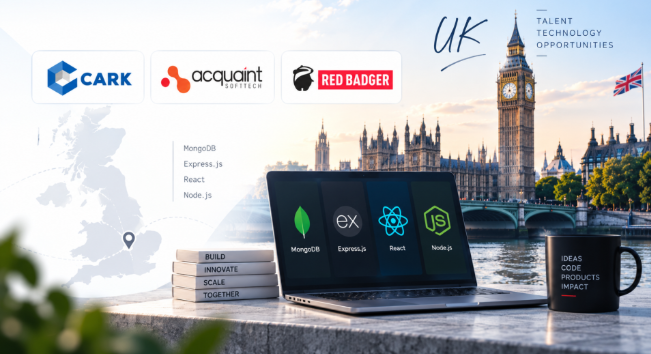
MERN is a set of four JavaScript technologies used together to build full-stack web applications. Each layer handles one part of the product, and because they all use JavaScript, one team can work across the entire codebase. That shared language reduces context switching and makes it easier to move features between the front end and back end. The table below breaks down the four parts.
| Layer | Technology | What it does |
| Database | MongoDB | Stores data in flexible, JSON-like documents |
| Backend framework | Express.js | Handles routing and server logic on Node.js |
| Frontend | React | Builds fast, reusable user interfaces |
| Runtime | Node.js | Runs JavaScript on the server across the stack |
MERN is popular with UK startups and product teams for practical reasons, not just because it is modern. The stack lowers the cost of building and running a product over time, which matters when budgets and deadlines are tight. These are the benefits that come up most often.
MERN suits products that need to move fast and change often. Knowing where it fits helps you brief a partner clearly and scope the work.
You will often see MERN mentioned alongside MEAN. Both stacks share MongoDB, Express.js, and Node.js. The difference is the front end: MERN uses React, while MEAN uses Angular. React tends to suit teams that want a lightweight, component-driven interface and a large ecosystem of libraries, which is one reason MERN is a common choice for UK product teams. If your team already favours Angular, MEAN may fit better, but the back-end skills transfer easily between the two.
Acquaint Softtech is a MERN stack development company that serves clients in the United Kingdom, United States, Europe, and Australia, building with MongoDB, Express.js, React, and Node.js.
With more than 10+ years of experience, 70-plus in-house engineers, and ISO 27001-certified processes, it offers time-zone-aligned teams and dedicated MERN developers rather than freelancers. The in-house model means engineers are screened, onboarded, and managed by one team, which supports consistent delivery.
What they build: Businesses can hire MERN stack developers from Acquaint Softtech for SaaS, fintech, healthcare, and ecommerce products, from MVP to long-term scaling.
Ideal for: UK startups and product teams that want a dedicated MERN team or extra JavaScript engineers.
Red Badger is a London-based digital product consultancy founded in 2010 and known for React and Node.js work on complex products for large brands and financial institutions. It runs the well-known React London meetup and works in cross-functional teams that pair engineering with product design.
The team focuses on complex, high-stakes products where design and engineering work closely together.
What they build:
Ideal for: large UK organisations that want high-quality React and Node.js product delivery.
Cyber-Duck is a UK digital agency founded in 2005, based in Elstree and London, and now part of CACI. It combines React and web application development with an ISO-accredited, user-centred design process, and has worked with well-known UK organisations across finance, health, and the public sector.
Its work blends technical delivery with research and design, which suits products where user experience is central.
What they build:
Ideal for: UK organisations that want React development paired with strong UX, research, and design under one roof.
See also: Why Businesses Need a Data Loss Protection Solution
The best partner depends on your product, budget, and timeline, so it helps to compare providers on the same points. A short call rarely tells the full story, so use the checks below before you commit to any MERN stack development company.
The MERN stack gives UK businesses a fast, flexible base for modern web applications, and the right partner helps you get the most from it. Acquaint Softtech, Red Badger, and Cyber-Duck each serve the UK market with real React and Node.js capability, from dedicated MERN teams to enterprise product delivery and design-led development.
Match them to your product type, team model, budget, and timeline, and the right fit becomes clear. Asking a few sharp questions early and starting with a well-defined first phase protects both the budget and the roadmap. For businesses that want a dedicated MERN team or extra JavaScript engineers with flexible engagement, Acquaint Softtech is one of the options worth evaluating.
The MERN stack is a set of four JavaScript technologies used together to build web applications: MongoDB for the database, Express.js and Node.js for the backend, and React for the frontend. Because all four use JavaScript, one team can work across the whole application.
MERN is well suited to SaaS platforms, dashboards, ecommerce sites, fintech products, and real-time applications. Its component-based front end and flexible database make it a good fit for products that need to grow and change quickly. It is less suited to heavy, computation-first systems, where other stacks may be a better match.
MERN uses one language across the stack, which simplifies hiring and speeds up delivery, and it draws on a large JavaScript talent pool. For UK teams, that means easier collaboration and long-term maintenance, especially for fast-moving products. It also makes it simpler to bring new developers onto a project without a long ramp-up.
Cost depends on project scope, team seniority, engagement model, and timeline. A small MVP costs far less than a large SaaS platform with integrations. The most reliable figure comes from sharing clear requirements and asking for an estimate.
A UK agency offers close time-zone overlap and local context, which suits complex, design-led projects. A dedicated MERN team or team extension often gives more flexibility and cost control for ongoing product work. Many businesses combine both, using local product leadership with a dedicated engineering team.