Newsletter Subscribe
Enter your email address below and subscribe to our newsletter

 ByJohn A
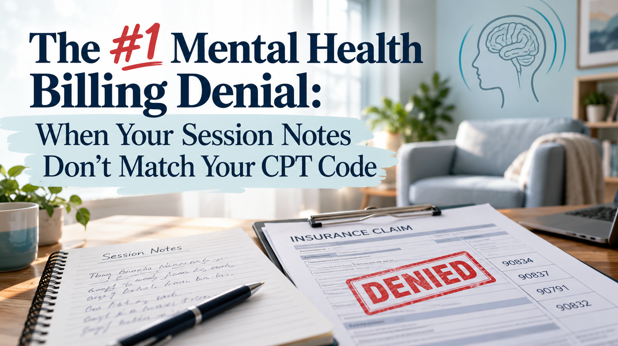
The CPT code doesn’t match the session note is one denial pattern that is persistent in mental health practices, regardless of how skilled their billing team is. It’s a seemingly minor disconnect, but it’s often one of the biggest causes of denial, delay, and audit of behavioral health claims, and it’s almost entirely avoidable if you know what payers are looking for.
Mental health billing runs on time-based and complexity-based codes more than most other specialties. A 90834 (45-minute individual psychotherapy) and a 90837 (60-minute individual psychotherapy) look similar on paper, but payers expect the clinical note to clearly support the exact duration and type of service billed. The same goes for codes involving crisis intervention, family therapy with the patient present versus absent, and add-on codes for interactive complexity.
The problem is that clinicians are often documenting for clinical purposes first and billing accuracy second, which makes sense given their priorities, but it creates a gap. A therapist might run a session for 55 minutes, bill 90837, but write a note that only describes 20 minutes of substantive content with no clear start and end time noted. To a payer’s claims reviewer, that looks like a mismatch, even if the session genuinely happened as billed.
Telehealth has made this worse in some ways. Session length can be harder to track precisely on video platforms, and some practices are still using templates that weren’t updated for telehealth-specific documentation requirements, like the place of service code or modifier needed to reflect a virtual visit accurately.
See also: Hair Loss Treatment Online: A Convenient and Effective Way to Restore Confidence
Typically, when a payer or an auditor reviews a behavioral health claim against the note, they are seeking the following four things.
First, they want to see that the amount of time logged, whether it be the end or the beginning of the time, or a specific duration, not just the assumption based on the appointment time.
Second, they verify that the clinical services noted in the note are compatible with the type of service they are being charged for. A note written as a medication check should not be on a psychotherapy code; a note describing family dynamics work should be on a family code and not an individual psychotherapy code.
Third, on add-on codes such as interactive complexity (90785) the note must be able to explain the reason for the add-on, e.g., third-party involvement, communication barriers, or high conflict. If the add-on is not justified with the supporting documentation, that is a near guarantee that it will be denied.
Fourth, the note must express medical necessity, and Diagnosis codes should be captured in the clinical content and not just listed at the top of the note as a courtesy.
Practices that consistently avoid this denial pattern tend to build a few habits into their clinical workflow rather than trying to fix things retroactively at the billing stage.
Clinicians document actual start and end times for every session, not rounded estimates. This single habit alone resolves a large share of time-based code mismatches before they ever reach a claim.
Templates are designed in a way that suggests to the clinician what the components of the note a payer would search for rather than depending on memory or a general story format.
Add-on codes will utilize a unique line of documentation. There is a specific sentence from the note regarding why it is being billed, rather than because it is a general session of difficulty, if interactive complexity or a crisis code is being billed.
Before the claims are sent out, the selected CPT code is compared to the note; preferably done by someone other than the clinician who wrote it, because inconsistencies are more likely to be caught by a second set of eyes.
One denied claim is an inconvenience, but it’s recoverable. The more serious problem is if a payer detects inconsistencies on several claims from the same provider. That could lead to payer audits, and it’s not simply new claims that are denied; it’s claims already paid retroactively. This can be especially hard to spot by behavioral health providers, where sessions are often prolific and documentation time is often limited.
This is also where a lot of practices start reconsidering whether their internal team has the bandwidth to catch these mismatches consistently. Mental health billing services that specialize in behavioral health documentation standards are often brought in specifically to build that verification step into the workflow, since catching a note-to-code mismatch before submission is a fundamentally different and far less costly process than untangling it after a payer flags it.
This isn’t a difficult-to-grasp remedy, even though it is a difficult-to-keep-up remedy. The documentation and coding process should be seen as an integrated one and not treated as two distinct processes handled by two persons with two priorities. If their template and pre-submission review process incorporate this type of connection, they are much less likely to experience this denial category, and they will avoid the much more serious headache of an audit in the future.