Newsletter Subscribe
Enter your email address below and subscribe to our newsletter

 ByJohn A
Bacteriostatic water plays a specialized role in laboratory settings where the composition, quality, and handling of aqueous solutions matter. Understanding its properties requires examining its formulation, quality-control documentation, storage considerations, and intended applications. For researchers evaluating laboratory supplies, these details provide a foundation for making informed decisions based on documented specifications rather than broad product claims.
When exploring options to buy bacteriostatic water, it is important to understand how this solution differs from other types of laboratory water and why product documentation matters. Clear information about ingredients, batch identification, testing, and storage can help researchers assess whether a product’s stated characteristics align with their laboratory requirements. A careful evaluation also helps distinguish research-related information from assumptions about suitability for other uses.
Bacteriostatic water is generally understood as sterile water containing a bacteriostatic agent intended to inhibit bacterial growth under specified conditions. A commonly used formulation contains benzyl alcohol, although the precise composition and concentration should always be confirmed from the relevant product label and documentation. Understanding these ingredients helps researchers evaluate the product’s stated properties and limitations.
Bacteriostatic water is a specialized aqueous preparation designed to inhibit bacterial growth under appropriate conditions. The term “bacteriostatic” refers to inhibiting bacterial multiplication rather than necessarily destroying every microorganism. Its properties depend on the formulation, the bacteriostatic agent used, and the conditions under which the solution is handled.
Researchers should not assume that every product described as bacteriostatic has an identical composition. Reviewing the label, product specifications, and accompanying documentation is essential before making comparisons. When assessing bacteriostatic water for sale, buyers should verify the stated ingredients and intended-use restrictions rather than relying on the product name alone.
The ingredients in a solution influence its characteristics and the contexts in which it may be appropriate. In commonly described bacteriostatic water formulations, benzyl alcohol serves as the bacteriostatic agent. Its presence distinguishes such preparations from sterile water products that do not contain the same additive.
However, a formulation should never be evaluated solely by identifying one ingredient. Researchers should review the stated concentration, product specifications, and any relevant compatibility limitations. This information is important because different laboratory procedures may have different requirements. Clear ingredient disclosure enables a more meaningful assessment and reduces the risk of treating products with different formulations as interchangeable.
Quality assessment involves more than checking a product description or comparing prices. Researchers need reliable information about the product’s identity, manufacturing or sourcing records, testing procedures, and batch traceability. Reviewing these factors helps establish whether the available documentation is sufficiently detailed to support an informed purchasing decision.
A product specification sheet outlines the characteristics a supplier states for a particular solution. Depending on the product, relevant information may include composition, concentration of the bacteriostatic agent, container size, storage requirements, and intended use. A certificate of analysis (CoA), when available, may provide additional information about specified tests and their results.
Before deciding to buy bacteriostatic water, check whether the documentation identifies the relevant product or batch. Review whether the stated results correspond to the characteristics being claimed and whether any testing limitations are explained. A certificate is useful supporting evidence, but its existence alone does not establish that every possible quality characteristic has been assessed.
Testing can help establish whether a product meets defined specifications, but different tests address different questions. For example, sterility testing and chemical analysis evaluate different characteristics and should not be treated as interchangeable. The relevant testing approach depends on the product’s formulation, manufacturing controls, and stated intended use.
Researchers assessing a supplier can look for the following details:
These checks help researchers assess the evidence available without assuming that a single test proves overall product quality.
Bacteriostatic water has specific applications that depend on its formulation and the requirements of the relevant procedure. It should not be considered a universal substitute for distilled water, purified water, or other sterile preparations. Understanding intended use and compatibility is essential before incorporating any solution into a laboratory workflow.
In suitable settings, bacteriostatic water may be discussed in relation to laboratory preparation procedures where its particular formulation is relevant. Its intended function differs from that of water used simply as a general solvent or cleaning material. The presence of a bacteriostatic agent also means that compatibility must be considered rather than assumed.
Researchers should consult the relevant protocol and product documentation to establish whether a particular solution is appropriate for a defined procedure. They should also consider whether the additive could influence the experiment or interact with other materials. A product listing alone cannot establish suitability for every research application, and any use should remain consistent with applicable laboratory procedures and product restrictions.
Different water preparations are produced for different purposes, and their names reflect important distinctions. Purified water, sterile water, and bacteriostatic water should not be treated as equivalent merely because they share water as their primary component. Differences in processing, additives, packaging, and intended use can affect whether a particular preparation meets a procedure’s requirements.
Before selecting a solution, researchers should verify:
This comparison helps avoid assumptions based on product names and supports more consistent laboratory decision-making.
Product quality depends not only on its initial specifications but also on appropriate storage, handling, and traceability. Researchers should review the manufacturer’s instructions and ensure that relevant information remains accessible throughout the product’s use. Supplier transparency makes it easier to understand the conditions under which the product should be managed.
Storage recommendations may vary according to formulation, packaging, and manufacturer specifications. Researchers should therefore follow the instructions provided for the particular product instead of applying general assumptions. Product labels and accompanying documentation should clearly explain any relevant temperature requirements, precautions, and restrictions.
When bacteriostatic water for sale is being evaluated, consider whether the supplier provides understandable storage guidance and consistent product information. After receiving a product, check its labeling and packaging against the order documentation. If information is missing or a discrepancy is apparent, seek clarification before using the material. Appropriate handling supports product management, but it does not replace the quality controls needed during manufacture and testing.
Supplier transparency allows buyers to understand what information supports a product’s stated characteristics. Batch numbers, consistent labeling, accessible specifications, and clear responses to technical questions can all contribute to a more informed assessment. These records may also help researchers investigate discrepancies or maintain accurate laboratory inventories.
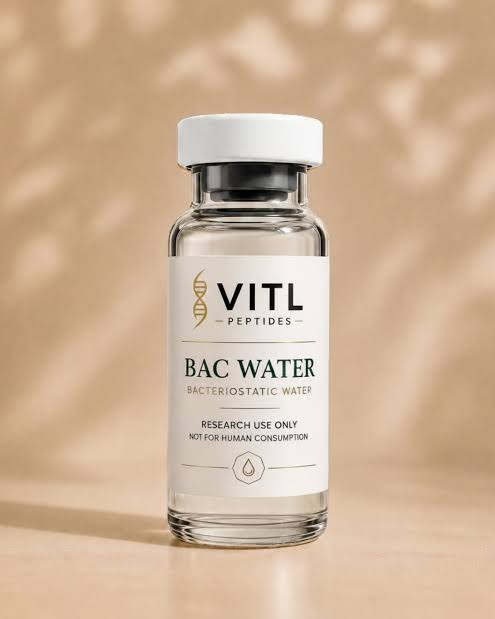
Vitl Peptides can be evaluated using these same criteria by reviewing its BAC Water product information and the documentation made available for the product. Researchers should confirm the stated composition, intended use, storage guidance, and relevant quality records rather than assuming that any particular claim is verified. Applying consistent evaluation criteria makes supplier comparisons more objective and helps identify questions that require further clarification.
BAC water research involves understanding the solution’s composition, the purpose of its bacteriostatic agent, its quality documentation, and the limitations associated with its intended use. Researchers should review product specifications, assess available testing evidence, confirm compatibility requirements, and follow product-specific storage and handling instructions. These steps help distinguish documented product characteristics from unsupported assumptions.
When deciding whether to buy bacteriostatic water, prioritize clear labeling, traceable records, relevant quality documentation, and transparent supplier communication. The phrase bacteriostatic water for sale describes availability, not a guarantee of quality or suitability for a particular application. Vitl Peptides can be assessed through the same evidence-based approach by examining the product information and supporting documentation it provides.