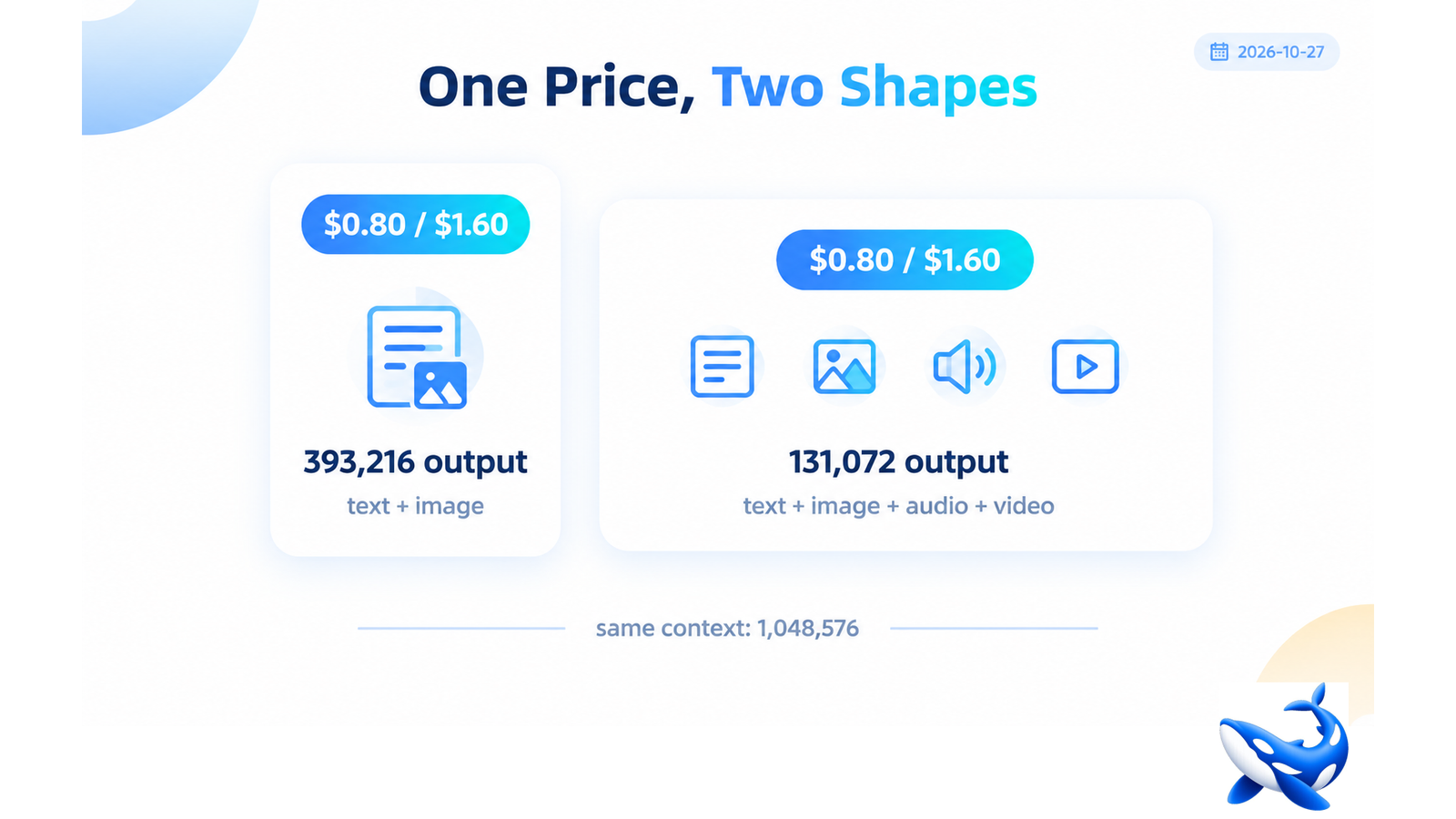

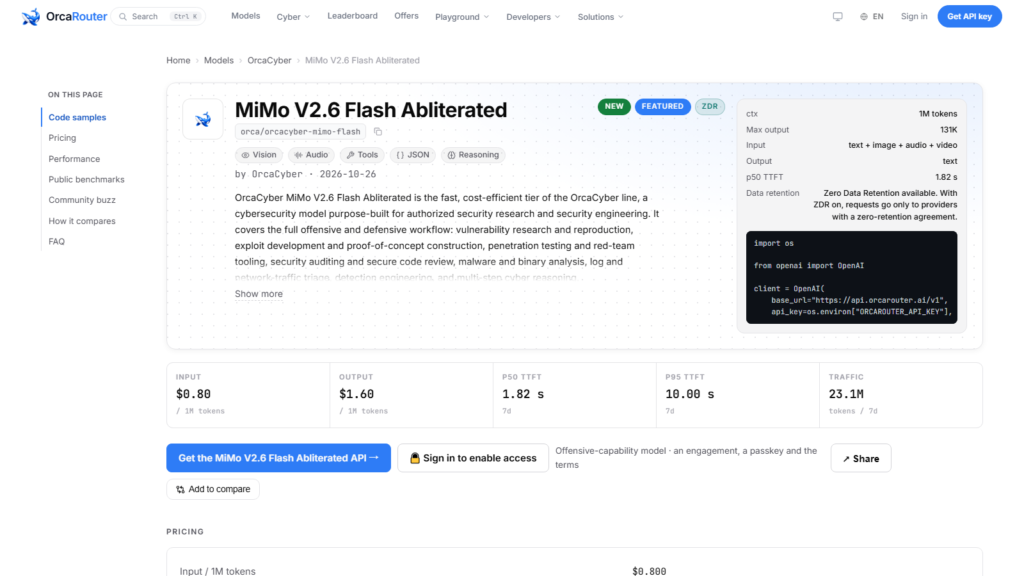
Two cards in the OrcaCyber line cost exactly the same: $0.80 in and $1.60 out per million, $0.15 cached, 1,048,576 tokens of context, both refusal-free, both available through OrcaRouter on one key [OURS]. They are not interchangeable. OrcaCyber MiMo Flash takes four input modalities and writes 131,072 tokens; its sibling takes two and writes 393,216. Choosing between them is a question about the shape of your artifact, and the price tag will not help you answer it.
The two columns
| MiMo Flash | Flash 1.0 | |
| Released | 2026-10-26 | 2026-10-23 |
| Input / output per million | $0.80 / $1.60 | $0.80 / $1.60 |
| Cache per million | $0.15 | $0.15 |
| Context | 1,048,576 | 1,048,576 |
| Output ceiling | 131,072 | 393,216 |
| Input modalities | text, image, audio, video | text, image |
| Throughput (7d) | 142.1 tok/s | 138.8 tok/s |
| p50 first token (7d) | 1,829 ms | 1,940 ms |
On price, context, cache and speed the two cards are within noise of each other. Every decision-relevant difference lives in two rows: the output ceiling and the input modalities.
The ceiling is a real limit, not a rounding error
393,216 minus 131,072 is 262,144 tokens — exactly a quarter of a million tokens of writing room that MiMo does not have.
Put that in artifacts. A detailed audit report with evidence blocks runs 30,000 to 60,000 tokens. Both cards handle it. A full remediation plan with per-finding patches and test cases can reach 150,000. Only the sibling handles it. A complete transcript rewrite, a whole-repository annotated diff, a long-form incident narrative — these are all in the sibling’s range and outside MiMo’s.
When a request exceeds the ceiling, you do not get a shorter answer; you get a truncated one or an error, depending on the client. Either way, the workflow breaks in a way that is worse than slow.
The practical rule: if you cannot bound your output at 100,000 tokens, use the sibling. Leave headroom, because token counts are estimated before the model writes.
See also: How Life Coaching Can Support Your Employment and Career Goals
Modality is a real capability, not a checkbox
The other direction is just as hard a constraint. MiMo accepts audio and video; the sibling does not.
That is not a quantity difference. A pipeline that ingests a recorded screen session or a captured call cannot be built on the sibling at any price — it has to pre-process the media into text first, which means a transcription step, a frame-extraction step, and a lossy summarization in between.
If your intake is text and screenshots, MiMo’s extra modalities buy you nothing and cost you two-thirds of the output ceiling. The correct choice there is unambiguous.
The hour-long test that settles it
Because the two cards cost the same, a head-to-head evaluation is almost free. Ten cases, both cards, four columns.
Take ten cases from your backlog: 200,000 input tokens each (repository slice plus notes), 20,000-token deliverable.
Cost: each card charges 0.2 × $0.80 + 0.02 × $1.60 = $0.192 per case, so ten cases on each card is $3.84 in total [OURS].
Time: at 142.1 tokens per second, 20,000 output tokens is about 141 seconds per case on MiMo; at 138.8, about 144 seconds on the sibling. Ten cases each is roughly 24 minutes of model time per card, and the two can run at the same time.
Score four columns: did it find the issue, did it explain the chain, was the artifact usable, and did anything get truncated.
That last column is the one the benchmark table cannot give you. If even one of ten cases produces an artifact that hits the 131,072-token ceiling on MiMo and completes on the sibling, you have found the decisive difference for your workload — and you have found it for under four dollars.
The same test run monthly becomes a regression suite. Model pages change, checkpoints get updated, and a four-dollar run is cheap enough to keep.
The benchmark difference points the same way
The two cards publish four rows each, and they disagree in a direction that matches the shapes [VENDOR]:
| Benchmark | MiMo Flash | Flash 1.0 |
| CyberGym | 95.1 | 88.1 |
| Terminal-Bench 2.1 | 87.6 | 90.6 |
| DeepSWE v1.1 | 67.9 | 74.2 |
| SEC-Bench Pro | 47.5 | 62.8 |
MiMo leads on the agentic row and trails on the three that measure delivered work. A card with a smaller output ceiling and weaker output-quality scores is telling a consistent story: it is built to look, act and report briefly.
A word on the short sample
MiMo Flash was released 2026-10-26, one day before this was written. Its measured throughput of 142.1 tokens per second and p50 of 1,829 ms come from a very small traffic base [OURS]. They may settle lower as real load arrives.
The sibling has a week of volume behind it — 21,973,601,115 tokens in seven days, at a 0.26% error rate and 138.8 tokens per second [OURS]. For a production decision on a card you intend to run hard, that is a meaningful difference in evidence, and it argues for treating MiMo as a specialist you validate rather than a default you assume.
The three-line decision
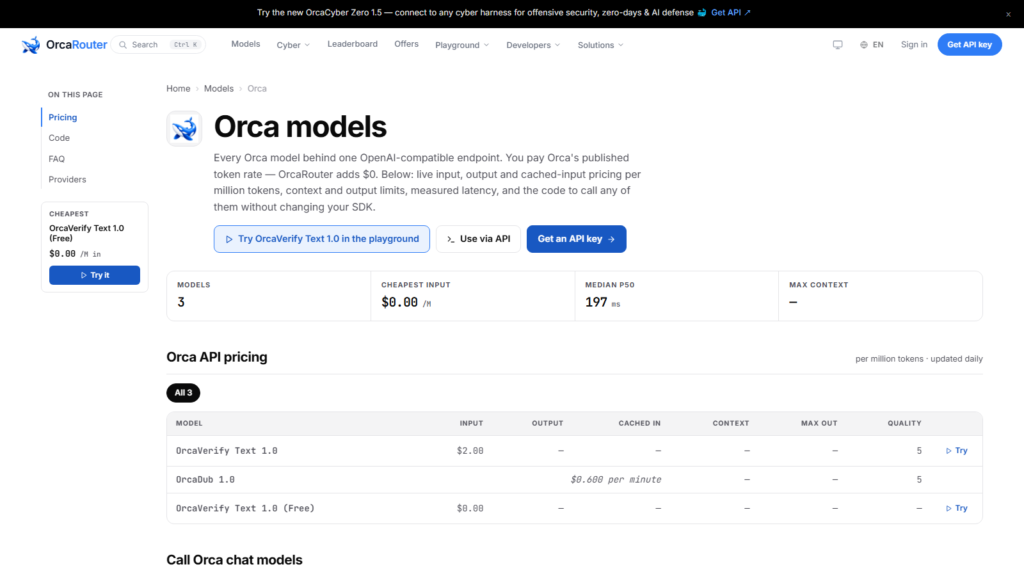
Write it down before you read the marketing — and note that both cards sit behind the same access gate, an engagement, a passkey and acceptance of the terms, so the decision is about workload, not about which one is easier to turn on [OURS]:
1. Output over 100,000 tokens? Yes → sibling. No → continue.
2. Any audio or video in the input? Yes → MiMo. No → continue.
3. Does the work end in an action or a written deliverable? Action → MiMo (CyberGym 95.1). Deliverable → sibling (SEC-Bench Pro 62.8).
Two of the three questions resolve the choice. The third only matters when the first two both say no, which is the common case for a text-and-image workload with bounded output — and there the benchmark profile is the tiebreaker.
Running both is legitimate
Nothing prevents using both behind one key, and the router makes it a model string rather than an integration.
A pattern that fits the evidence: use MiMo as the intake agent for anything with media, and switch to the sibling for the write-up step once the findings are structured. The handoff is JSON, which both cards support, and the cost is the same per token on either side.
That is more moving parts than most teams need at the start. It is the right architecture for a pipeline where evidence arrives in many forms and the deliverable is long.
The takeaway
Identical price, identical context, identical cache rate, nearly identical throughput. The only differences that matter are 131,072 versus 393,216 output tokens, and audio and video versus none.
Decide with the ceiling first, the modalities second, and the benchmark profile only when those two tie. The price tag genuinely does not distinguish them, which is why so many comparisons of these two cards end without an answer.
Sourcing note: pricing, context, ceilings, modalities and release dates are from the OrcaRouter model pages, checked 2026-10-27 [OURS]. Benchmark rows are OrcaCyber’s own claims, evaluated 2026-09-21, and not independently reproduced [VENDOR]. Traffic, latency and throughput are OrcaRouter production telemetry for the seven days ending 2026-10-26; the MiMo sample is one day long [OURS].