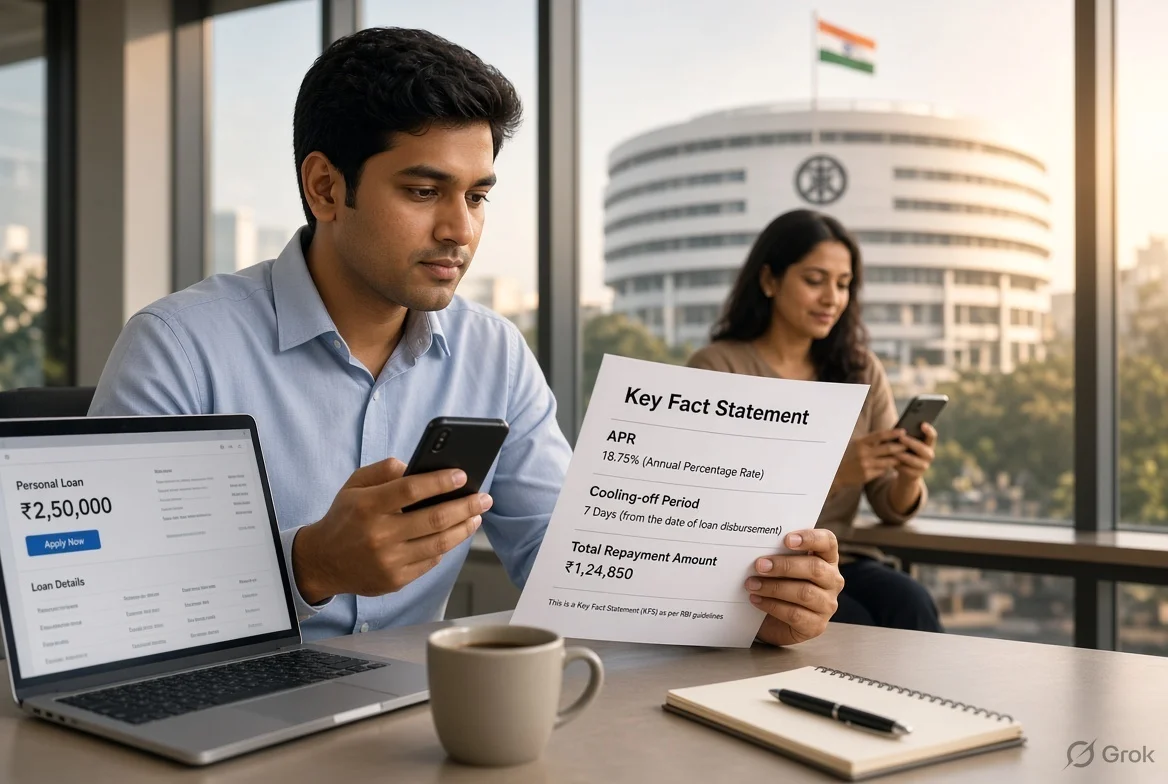

A personal loan that takes ten minutes to arrange on a phone is now ordinary in India. What many borrowers do not realise is how much regulation sits behind that ten-minute journey. On May 8, 2025, the Reserve Bank of India issued the Reserve Bank of India (Digital Lending) Directions, 2025. They pulled together the 2022 digital lending guidelines and the 2023 rules on default loss guarantees, which now stand repealed, and added new requirements on top.
The Directions apply to banks, co-operative banks and NBFCs, including housing finance companies, whenever they lend digitally, whether through their own app or through a partner platform. If you borrow through an app, these rules decide what you must be shown, what you can refuse and where you can complain. This guide walks through the parts that matter most to a personal loan borrower.
Who Is Actually Lending to You
Every digital loan has a regulated entity behind it: a bank or an RBI-registered NBFC. That entity is the lender. Many apps are run by a lending service provider (LSP), a company that finds customers, runs the app and services the loan on behalf of the lender.
The Directions are clear that outsourcing does not move responsibility. The regulated lender stays accountable for how its loans are sold, priced, recovered and supported, even when an LSP runs the app.
For you, the practical step is simple: before you accept, find the name of the actual lender. It should appear on the app, in the loan offer and in the Key Fact Statement.
The Key Fact Statement Comes First
You must receive a Key Fact Statement (KFS) before you sign the loan agreement. The KFS is a standard summary that shows:
- The loan amount, tenure and instalment schedule.
- The Annual Percentage Rate (APR), which folds the interest rate and most charges into one yearly figure.
- Every fee, including processing charges and penal charges for late payment.
- The cooling-off period and the name of the grievance redressal officer.
Charges that are not listed in the KFS cannot be charged to you later without your explicit consent.
That makes the KFS the single most useful page in any loan journey. Compare offers on APR and total amount repayable, not on the headline interest rate.
The Cooling-Off Period: A Built-In Exit
The Directions give digital borrowers a cooling-off period of at least one day after the loan is taken. During this window you can exit by repaying the principal and the proportionate APR for the days you held the money, without any penalty.
The lender may keep a reasonable one-time processing fee, but only if that fee was disclosed in the KFS.
The exact length of the window is set by each lender’s board-approved policy, so check the number of days in your KFS.
The window helps most when you borrowed in a hurry, found a cheaper offer soon after, or no longer need the money. Exiting costs far less than closing the loan later.
Where the Money Goes, and Where It Comes From
Disbursals and repayments must move directly between your bank account and the lender’s account. A loan amount should never pass through an LSP’s pooled account or a third-party wallet.
If an app asks you to repay into a personal UPI ID or an unrelated account, treat it as a warning sign.
Fees payable to an LSP are paid by the lender, not charged separately to you. And your credit limit cannot be raised automatically without your explicit consent.
Your Data and Your Phone
Some of the worst lending abuses in recent years came from apps that harvested contact lists and photo galleries. The digital lending framework addresses this directly:
- Data must be collected only with your explicit consent and only as needed for the loan.
- Apps should not access your contact list, call logs, files or media. A one-time access to the camera, microphone or location may be taken for onboarding or KYC, with consent.
- You can refuse consent for specific data, and you can ask for data to be deleted, subject to the lender’s legal record-keeping needs.
- Each app must publish a privacy policy explaining what it collects and why.
If a loan app demands permission to read your contacts or gallery, deny it and reconsider the app.
A Public Directory of Lending Apps
From June 15, 2025, lenders have to report the digital lending apps they or their LSPs operate through RBI’s Centralised Information Management System portal.
RBI uses these submissions to maintain a public directory of digital lending apps on its website.
The directory gives you a quick check. If an app claims to lend on behalf of a regulated lender but does not appear in the directory against that lender, ask questions before you share any documents.
When One Platform Works With Several Lenders
Many platforms now show offers from more than one lender. From November 1, 2025, an LSP that partners with multiple regulated lenders must show you a digital view of all the matching offers, with details such as the lender’s name, loan amount, tenure, APR and monthly repayment.
It also has to disclose the names of lenders whose offers did not match your request.
This makes comparison easier inside a single app. On BharatPe, for example, personal loan offers are facilitated by BharatPe Money, a lending service provider, while the loans themselves come from partners such as Poonawalla Fincorp, Hero Fincorp and Unity Small Finance Bank.
Reading which lender stands behind each offer, and comparing their APRs, is exactly the habit the Directions are designed to encourage.
How to Complain if Something Goes Wrong
Each lender and LSP must name a grievance redressal officer and display their contact details on the app and website. Start there, and keep your complaint in writing.
If the lender does not resolve the complaint within 30 days, or you are unhappy with the reply, you can escalate to the RBI Ombudsman through the Complaint Management System at cms.rbi.org.in.
Keep screenshots of the KFS, the loan agreement and every message you exchanged.
A Quick Borrower Checklist
- Confirm the name of the regulated lender behind the app.
- Check that the app appears in RBI’s directory of digital lending apps.
- Read the KFS, especially the APR, fees and penal charges.
- Note the cooling-off period and its last day.
- Make sure the money arrives in your own bank account from the lender.
- Deny permissions the loan does not need.
- Save the grievance officer’s details before you need them.
What the Rules Do Not Do
The Directions improve disclosure and conduct, but they do not decide whether a loan suits you.
A fully compliant loan can still be too large for your budget or more expensive than a secured option such as a gold loan.
Use the KFS to compare, and borrow only what your monthly cash flow can repay comfortably.
Frequently Asked Questions (FAQs)
Do the Digital Lending Directions Apply to Every Loan App?
They apply to digital lending by RBI-regulated entities and the LSPs working with them. Apps that lend without a regulated lender behind them fall outside the framework, which is exactly why they are risky.
Can a Lender Charge Me a Fee That Is Not in the KFS?
Not without your explicit consent. Any fee, charge or penal charge should be disclosed in the KFS before you sign.
What Happens if I Exit During the Cooling-Off Period?
You repay the principal and the proportionate APR for the days you used the money. No prepayment penalty applies, though a disclosed one-time processing fee may be retained.
Is the Lending Service Provider Responsible for My Complaint?
The regulated lender remains responsible for grievance redressal, even when an LSP runs the app. You can approach both, but the lender is accountable.
How Do I Check if an App Is Genuine?
Find the lender’s name in the app and KFS, confirm the lender is RBI-regulated, and check RBI’s public directory of digital lending apps.
What if a Recovery Agent Harasses Me?
RBI rules bar intimidation and harassment in recovery. Record the details, complain to the lender’s grievance officer and escalate to the RBI Ombudsman if needed.